We enjoy making children’s cakes, but it is a different discipline from weddings. At a wedding, adult taste and aesthetics decide. At a child’s party, the chief critic is a six-year-old who remembers exactly what that dragon was supposed to look like and will tell you bluntly that it did not work out.
Truth one: children do not eat fondant
Fondant is beautiful in photos and tastes like sweet modelling clay. Children push it to the edge of the plate. So we use it purposefully — for the covering and modelled elements — but underneath there has to be a sponge and a filling children will actually eat. Combinations that work:
- vanilla sponge + light cream filling + a strawberry or raspberry layer
- cocoa sponge + milk chocolate filling (not dark — children reject it)
- sponge with plain yoghurt and peaches — light enough to eat after four sandwiches
Truth two: dark colours cause trouble
Dark blue, black and deep red require enormous amounts of colouring. You can taste it — dye is bitter — and it stains tongues, teeth and occasionally T-shirts. Party photos where every child has a blue mouth are funny for five minutes and then they are not.
What we offer instead: put the dark colour on a small area only (a detail, lettering, part of a figure) and keep the main surface in pastel tones. Or use an edible printed topper on sugar paper, which needs far less dye and comes out sharper.
We made about forty children’s cakes last year. The ones parents rated highest had one strong figure and an otherwise simple surface. The cakes that tried to have everything ended up looking cluttered.
Modelled figure versus printed topper
A figure modelled from fondant or modelling paste is handwork. A character with a face is 60 to 90 minutes of work and has to be made at least three days ahead so it hardens. That is why it costs more and why we cannot do it for tomorrow.
An edible printed topper is cheaper, faster, and for cartoon characters often more faithful than anything we could sculpt. We need an image at a sensible resolution — a photo of a phone screen prints blurry. We apply the print onto a fondant or buttercream surface on the day of collection, because sugar paper absorbs moisture over time and the colours bleed.
Size and guests
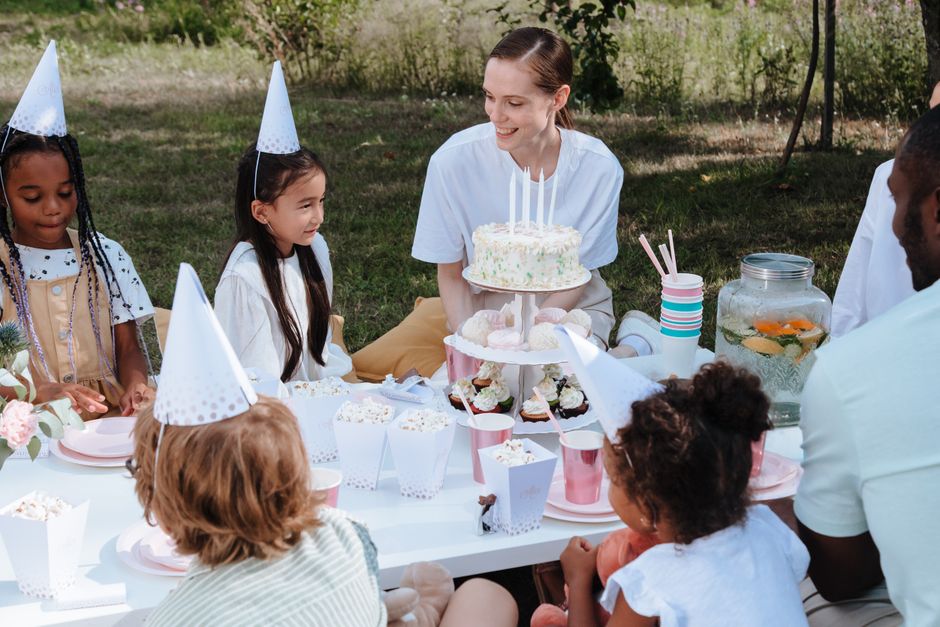
Count portions for children and adults separately. A child eats 50 to 70 g of cake, an adult 100 g. For a party with ten children and eight parents, a cake of around 1.8 kg (20 cm diameter) is plenty. Everything else on the table takes care of the rest — and there is usually far too much of it.
Practical notes for the day
- Push the candles in just before the singing, not an hour ahead — they lean in the warmth.
- Keep the cake chilled until it is cut. A children’s party easily hits 26 °C indoors.
- If there is a figure the child will want to keep, tell us. We can set it on its own small base so it can be lifted off without being smothered in cream.
- Cut the slice the child holds for photos smaller than you think. Half of a big one ends up on the floor.
Budget, and where you can save
The most expensive part of a children’s cake is not the ingredients, it is the hours. A hand-modelled scene with three characters is four hours of work, and that shows in the price far more than twice the chocolate would. If you have a fixed budget, tell us straight away and we will suggest how to spend it: one figure and a simple surface instead of a full scene, or a printed topper with a single modelled detail. Children remember the one thing they asked for — the dragon, the digger, the unicorn. The rest of the cake, honestly, they do not care about.
Children’s cakes are ordered at least 48 hours ahead; allow a week if you want a modelled figure. Call 0948 128 000 and tell us what the child likes — we will work the rest out together.