When customers pick a cake, they usually think about flavour and colour. We ask something else: where will the cake stand, and for how long? That decides which filling we use, and the filling decides whether the cake still looks at six in the evening the way it did at noon.
Buttercream: the workhorse
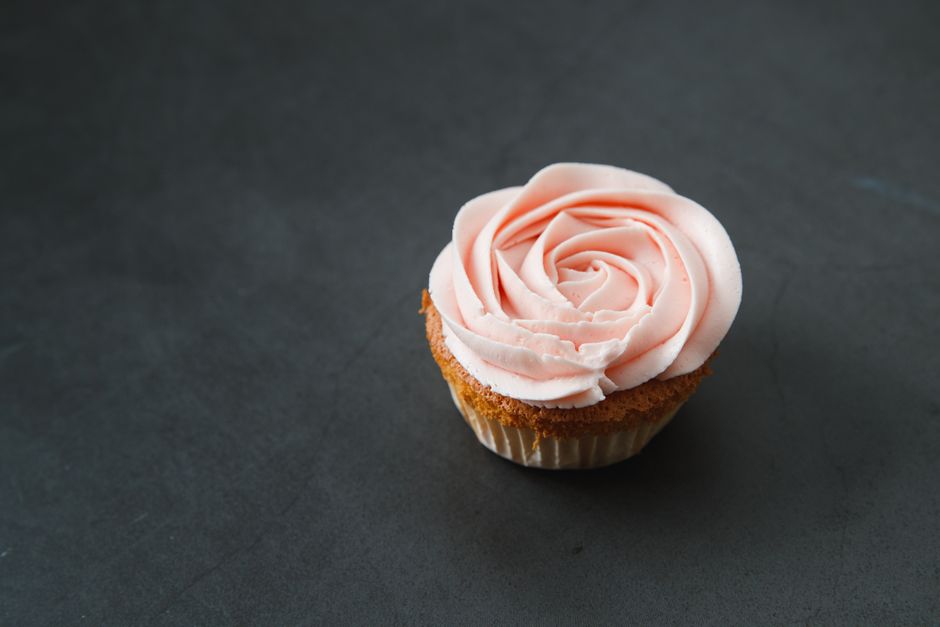
We build ours on an egg-yolk base — yolks, sugar and milk cooked to a custard, cooled to 22 °C, then 82 % butterfat butter beaten in spoon by spoon. The crucial part is that the base and the butter are at the same temperature. If the base is warmer, the cream splits and looks like cottage cheese. It can be rescued — a few seconds over steam, keep whisking — but it is needless drama.
- Holds its shape for 4 to 6 hours at 22 °C.
- Takes fondant, sharp edges, printed toppers, and heavy tiers stacked on top.
- Downside: straight from the fridge it is hard and tastes of butter. Give it at least 45 minutes to temper.
Whipped cream: fragile, but delicious
We whip 33 % cream chilled to 4 °C in a cold bowl and stabilise it with mascarpone or a minimal dose of gelatine (3 g per 500 ml). Unstabilised, it keeps its shape for barely two hours.
A whipped-cream cake at a summer garden party at 2 p.m. in 30 °C heat is not a bold choice, it is a lost bet. We would rather tell you before you order it.
Cream is light, not sweet, and it simply belongs with fruit. A raspberry cake with buttercream is heavy, and nobody comes back for seconds. With whipped cream, even the people who “don’t eat sweets” ask for another slice.
Storage, where things usually go wrong
- Whipped cream: 2 to 6 °C, eat within 48 hours. Never store it next to cut onion or cheese — dairy fat absorbs smells like a sponge.
- Buttercream: 2 to 8 °C, good for 4 to 5 days. Cover it, but not with cling film pressed onto the surface, or you will peel the finish off. A box or a dome is ideal.
- Freezing: buttercream freezes fine (30 days, thaw overnight in the fridge). Whipped cream does not — it weeps water once thawed.
What about ganache?
The third option almost nobody asks for, although it is the best one for summer. Ganache made from 55 % dark chocolate and cream in a 2:1 ratio survives a full day on the table at 26 °C, tastes less sweet than buttercream, and can be smoothed to a razor edge. We make it a day ahead and let it crystallise at room temperature, not in the fridge — chilled, it goes dull and splits when whipped.
How to decide in thirty seconds
Indoors, eaten within two hours, you want fruit — whipped cream. On the table longer, more than a 20-minute car ride, printed image or a figurine on top — buttercream. It is July, it is 30 °C, the party is outside — ganache or buttercream, and keep the cake cold right up to the cut.
The mistake we see most often
A customer collects a whipped-cream cake in the morning, drives around with it all day, and by evening wonders why it no longer looks like it did in the display case. At 25 °C cream loses structure after roughly two hours — first the edges soften and round off, then a thin layer of water pools underneath. It cannot be undone; once cream has wept, chilling it again will not restore the shape. If you must collect early, bring a cool box and two ice packs. It sounds excessive, but it is the difference between a cake you want to photograph and one you would rather nobody saw.
It is not about which cream is “better”. It is about which one survives your day. Ask us when you order — call 0948 128 000 or write to daniela@nakolace.sk, ideally at least 48 hours ahead.