Every year around 18 December someone calls asking whether they can order six kinds of Christmas baking for the 22nd. Usually they cannot. Not because we do not want to, but because an oven has a capacity, and in December it runs from morning to night.
The real ordering calendar
- Until 30 November: order anything — hand-iced gingerbread, Christmas cakes, large quantities.
- 1 – 10 December: still comfortable, larger orders welcome. This is the sensible window.
- 11 – 15 December: limited selection; intricately decorated gingerbread is usually off the table.
- After 16 December: we only take what is already in a batch or can be added to one. Corporate orders over 5 kg are declined at this point.
- 23 and 24 December: pre-paid orders only. No new ones.
The same 48-hour minimum applies as all year round, but in December it is a theoretical limit — capacity sells out long before time does.
Why some baking has to happen early
It is not about scheduling. It is about how dough behaves over time.
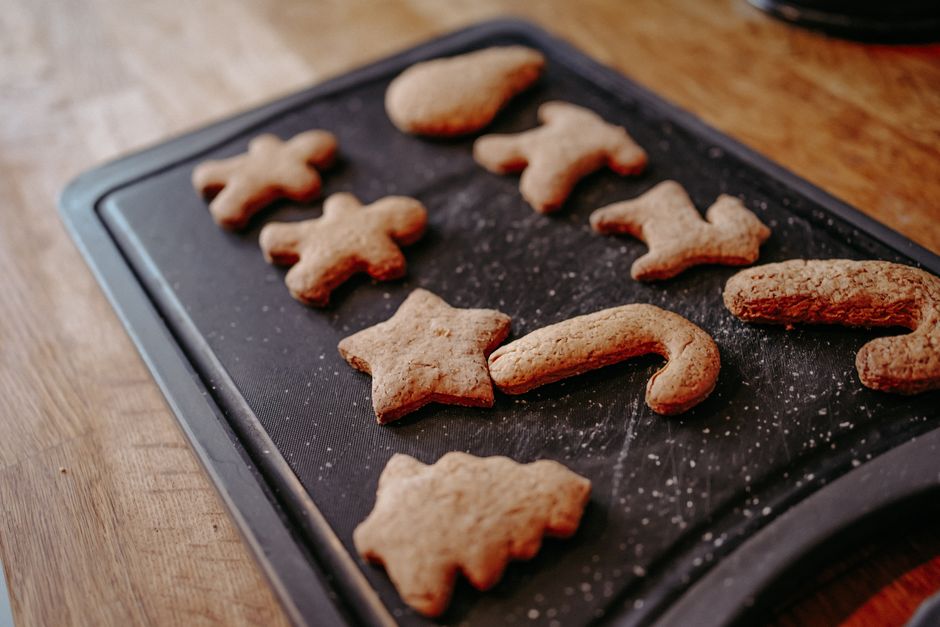
Gingerbread comes out of the oven hard as stone. It has to soften — stored in a box with a slice of apple for 7 to 14 days, it gradually takes up moisture. Gingerbread baked on 22 December will break a tooth on Christmas Eve. That is why we start baking it in late November and ice it as we go.
Linzer biscuits are baked first but filled only in the final week. Unfilled shells keep for three weeks in a dry box; fill them with jam too soon and they soften and crumble. The sweet spot is 3 to 5 days before serving.
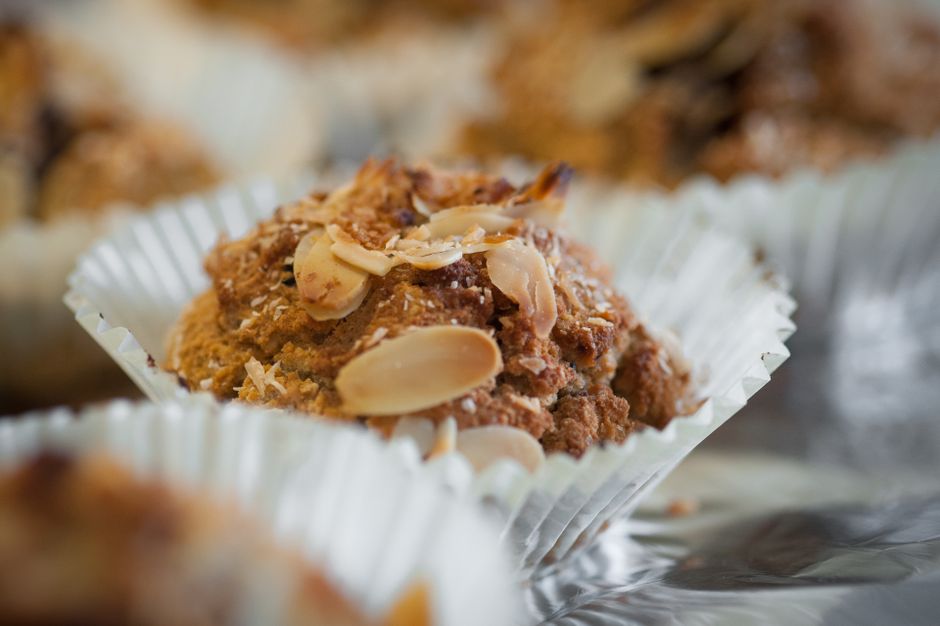
Vanilla crescents and walnut cups are heavy with butter and nuts, so after a fortnight the fat oxidises and they start to taste stale. We make those as late as we can, usually between 15 and 20 December.
The order in which we bake mirrors the order in which things go stale. None of it is arbitrary, and none of it can be squeezed into the last week.
How to store it at home
- One kind per box. Put gingerbread next to Linzer biscuits and the biscuits absorb the moisture and soften while the gingerbread loses it and hardens.
- Tins beat plastic containers — plastic traps condensation.
- A cool pantry at 12 to 16 °C. Not the fridge — biscuits dry out there and pick up odours.
- You can freeze them for up to six weeks; thaw them in a closed box at room temperature, not in the open air.
What else the holidays bring
The season also brings orders for strudels, festive cakes and savoury platters — for New Year’s Eve the platter and banquet orders pile up exactly as gingerbread orders do in December. Platters can be arranged on shorter notice, but we always need 48 hours.
How much to order
The rule of thumb is 250 to 300 grams of Christmas baking per person for the whole season, which for a family of four with visitors works out at roughly 1.5 to 2 kg. It sounds like a lot, but split across five or six varieties it is one small box of each. For corporate gift boxes we count 150 grams per recipient. If you are unsure, order less — you can always top up, whereas the surplus gingerbread that turns to stone by January will not be saved even by a slice of apple in the tin.
Our shop on Námestie Andreja Hlinku runs shortened hours over the holidays; we announce them by phone and on social media. Orders: 0948 128 000, daniela@nakolace.sk. Minimum order 15 €.